
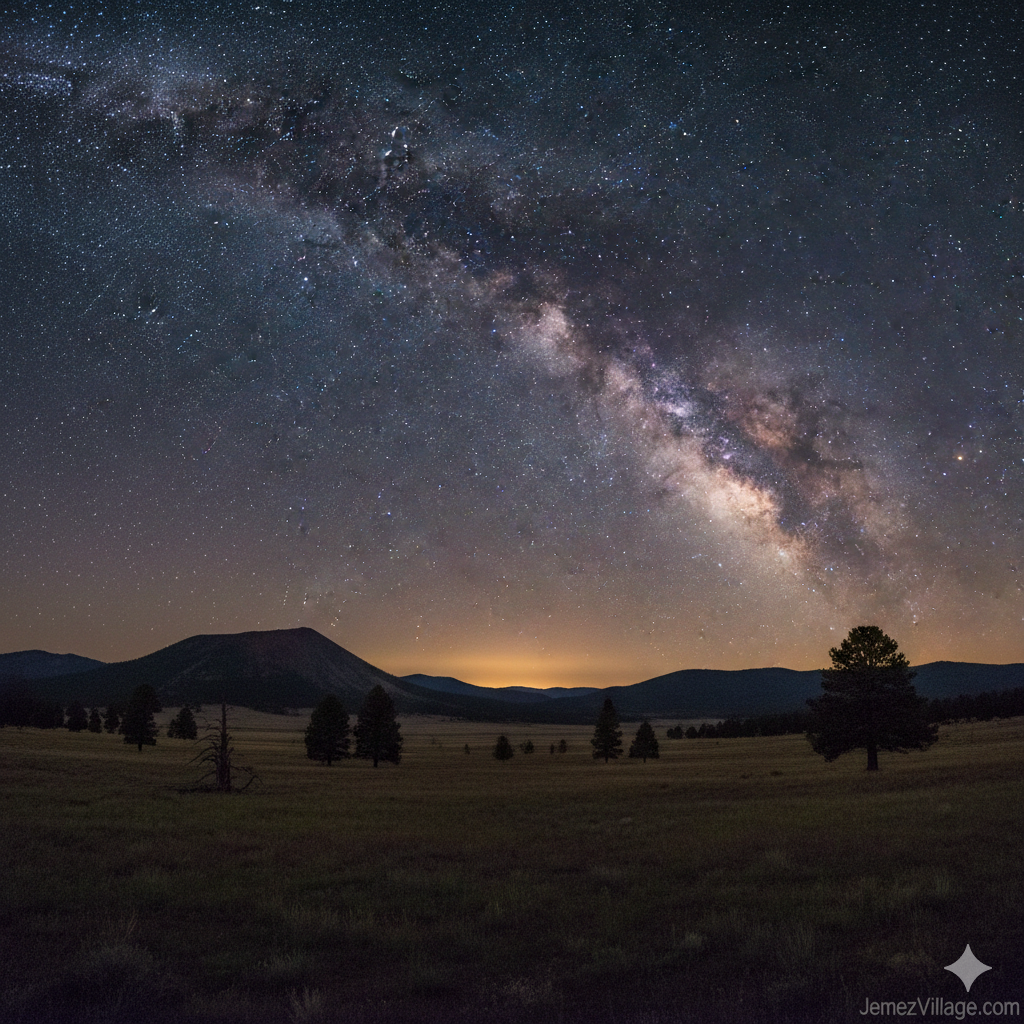
At JemezVillage.com, we are the stewards of one of the most magnificent landscapes on Earth. From the high-altitude ranchers in the Valles Caldera to the craftsmen and hot-spring seekers in Jemez Springs, we are the “Gatekeepers of the Dark.”
But there is a silent drain on our community—the “Ghost Light.” These are the outdoor fixtures we leave on all night out of habit. When we look at the data, it’s clear: these lights are costing us money, affecting our mental health, and stealing the very stars that define our home.
1. The Financial & Carbon Hit: Why Your Wallet is Leaking
Many neighbors leave a porch or floodlight on 24/7 for “security.” But the math tells a different story. If you’re leaving unshielded lights on throughout the night, you are effectively paying a “darkness tax.”
The Cost: Leaving just one 100W-equivalent LED bulb on all night costs about $9–$15 per year. If you have five fixtures (typical for a small ranch or shop), that’s $75 a year gone.
The Carbon Footprint: In the U.S., residential outdoor lighting emits 15 million tons of $CO_2$ annually—equivalent to the emissions of 3 million cars.
The Waste: At least 30% of all outdoor lighting is wasted because it’s poorly aimed or left on when no one is there.
2. The Bio-Hertz Hack: Why Cheap LEDs Make You Tired
Modern LEDs don’t just “glow” like old bulbs; they pulse. This is called Temporal Light Modulation (TLM), and it has a profound impact on our well-being.
The 60Hz-120Hz Struggle: Low-quality LED drivers flicker at rates your eyes can’t see, but your brain can. This “invisible flicker” is a massive driver of cognitive fatigue, headaches, and “brain fog.”
The “Phantom Array”: Have you noticed a “strobe” effect when you move your eyes quickly at night? That’s low-hertz flicker. It forces your brain to constantly “re-map” your surroundings, leading to irritability and sensory overload.
Melatonin Suppression: Cheap “cool white” LEDs ($5000K+$) blast blue light that tricks your brain into thinking it’s noon. For our local growers and ranchers, this disrupts your natural sleep cycle and the biological rhythms of your livestock.
3. Preserving the Caldera & Our Local Code
We are neighbors to the Valles Caldera National Preserve, an International Dark Sky Park. Our “sky glow” from the canyon can be seen from the Valle Grande, washing out the Milky Way for future generations.
The Jemez Springs Lighting Code (Chapter 51) isn’t just a rule—it’s a tool:
Curfew: All non-essential lights must be OFF between 11:00 PM and Sunrise.
Shielding: All fixtures must be “Full Cutoff”—aimed at least 25° below the horizontal.
Brightness: Stay under 1,260 Lumens per fixture (about a 75W-100W equivalent).
The “Dark Sky” Checklist
How do we fix this without living in total darkness? We use Modern Tech.
Switch to Motion Sensors: A light that turns on when someone approaches is a better deterrent than a constant glow. It also cuts your energy bill by 90%.
Go Amber (CCT < 3000K): Use “Warm” or “Amber” bulbs. They scatter less in the atmosphere and are gentler on your brain’s circadian rhythm.
Demand “Flicker-Free”: Look for bulbs labeled “Flicker-Free” or with High-Frequency PWM (Pulse Width Modulation) drivers. Your brain will thank you.
A Call to the Jemez Community
Just because the lights of Rio Rancho and Albuquerque are creeping over the horizon doesn’t mean we have to follow suit. Let’s lead the way. Flip the switch. Save the money. See the stars.

This may be my favorite article thus far. Thank you for all the great information on how we can all help improve and preserve what makes this place so magical.
I caught the LED strobe effect in action recently. By moving a flashlight rapidly, I could see the distinct pulses of light caused by the refresh rate—gaps you’d never notice otherwise. These cycles likely force our brains to sync with an unnatural frequency, potentially slowing us down and causing depression. It makes you wonder about the forced transition to LEDs; it seems designed to keep us out of sync with our natural cycles and mentally suppressed.